

 Image 1 of 1
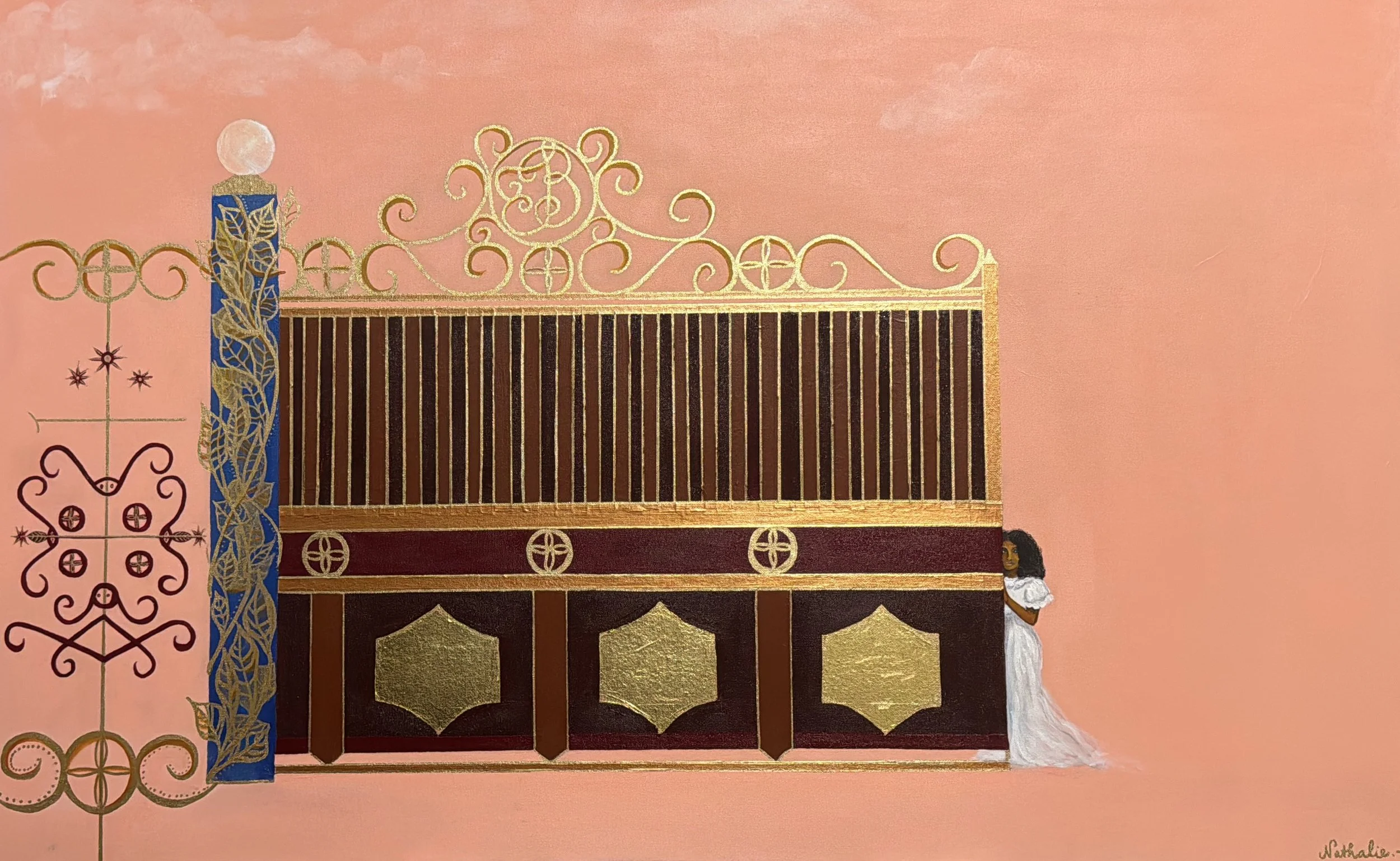
Description: Being told you can’t cross the very threshold that will lead to your freedom can push you to ‘Ouvè bayè a, "Open the gate,". This painting is a literal dare and spiritual request: In Haitian Vodou, Papa Legba is the loa of crossroads and thresholds who must open the gate between the material world and the divine before any other spirit can pass. His vèvè, drawn beside the gate marks this as a key. The painting holds a personal tension between what it means to stand at a threshold you're told not to cross and stand by. A gate that succumbs to the artist’s ownership to keep watch over.
This work carries a family inheritance hiding in plain sight. In Haiti, red gates are landmarks and reference point in giving directions. The artist’s childhood gate had swirling lines found in traditional Haitian ironwork and vèvè design which resemblance is usually never traced back to Vodou iconography, yet reproduced faithfully in every Haitian household anyway. ‘Ouvè Bayè’ is an unknowing continuity: Legba at the gate with ironwork, and a woman standing at this threshold.
Description: Being told you can’t cross the very threshold that will lead to your freedom can push you to ‘Ouvè bayè a, "Open the gate,". This painting is a literal dare and spiritual request: In Haitian Vodou, Papa Legba is the loa of crossroads and thresholds who must open the gate between the material world and the divine before any other spirit can pass. His vèvè, drawn beside the gate marks this as a key. The painting holds a personal tension between what it means to stand at a threshold you're told not to cross and stand by. A gate that succumbs to the artist’s ownership to keep watch over.
This work carries a family inheritance hiding in plain sight. In Haiti, red gates are landmarks and reference point in giving directions. The artist’s childhood gate had swirling lines found in traditional Haitian ironwork and vèvè design which resemblance is usually never traced back to Vodou iconography, yet reproduced faithfully in every Haitian household anyway. ‘Ouvè Bayè’ is an unknowing continuity: Legba at the gate with ironwork, and a woman standing at this threshold.